
Heritage as Economic Identity: The Case of Rajna Aleksova
In heritage interpretation, the greatest challenge is often not the lack of content, but the passivity of that content.
Historical figures, places and events too often remain trapped in the format of a memorial plaque: static, respectful, but unable to generate emotional, educational or economic value for the contemporary community.
The story of Rajna Aleksova is a powerful example of this challenge.
Recognized as the first female pharmacist in Macedonia and often referred to as one of the first women pharmacists in the Balkans, Rajna Aleksova represents much more than a historical fact. Her life connects women’s education, science, European knowledge, professional courage and the urban identity of Bitola (Macedonia).
But a historical fact alone is not enough.
To become relevant today, it needs interpretation.
From facts to experience
Rajna Aleksova’s story holds strong potential for a heritage-based brand. However, transforming this potential into a meaningful and sustainable cultural product requires more than archival documentation.
It requires experience design.
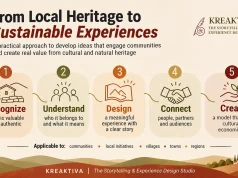
At Kreaktiva – The Storytelling & Experience Design Studio, we approach such heritage challenges through three key layers.
1. Interpretive reconstruction
The first step is to transform historical facts into a narrative that is relevant to contemporary audiences.
Rajna Aleksova should not be interpreted only as a pharmacist. She can be understood as a symbol of persistence, professional excellence and European scientific education placed within a Macedonian context.
Her story connects Lausanne and Bitola, pharmacy and women’s history, local identity and international knowledge. This is precisely where its interpretive strength lies.
2. Live interpretation
When history is experienced through performance, space, atmosphere and sensory design, it stops being a lesson and becomes a memorable encounter.
Imagine a carefully designed space inspired by Rajna’s world: the scent of dried herbs, pharmacy jars, handwritten prescriptions, scientific instruments, the urban rhythm of Shirok Sokak (main street in Bitola) and the presence of a woman who returned from Switzerland not to fit into expectations, but to set a new professional standard.
This is where live interpretation becomes a powerful tool.
It allows visitors to experience heritage emotionally and intellectually, without reducing it to folklore or decoration.
3. Value-based branding
The result of this process can be a sustainable heritage-based brand.
This does not mean superficial commercialization. It means creating products, programmes and experiences that respect the authenticity of the story while generating cultural and economic value.
In the case of Rajna Aleksova, this could include interpretive programmes, educational formats, live history experiences, concept products inspired by pharmacy heritage, or partnerships focused on women, science, local identity and cultural diplomacy.
The key is not to use history as decoration.
The key is to build a brand from the values embedded in the story.

The professional challenge
The problem at local level is rarely the absence of history. More often, the problem is the methodological gap in how that history is presented, interpreted and managed.
Heritage is living material, not an object locked behind glass.
When a historical narrative is designed with precision, it can become one of the strongest identity-based and economic assets of a community.
Rajna Aleksova’s story is not only worth remembering.
It is worth developing.
The question is not whether this story has value. The question is how it can be professionally interpreted, designed and managed as a meaningful heritage experience and a sustainable cultural brand.
The Kreaktiva approach
Kreaktiva works at the intersection of heritage interpretation, storytelling, live interpretation and experience design.
Our role is to transform heritage from passive content into active experience: something people can understand, feel, remember and share.
The case of Rajna Aleksova shows how one historical figure can become the foundation for a wider cultural concept, one that connects identity, education, diplomacy and sustainable local economy.
Because when heritage is interpreted with care and designed with vision, it becomes more than memory.
It becomes value.
Author:
Vasilka Dimitrovska, MSci
Experience Designer & Heritage Innovation Strategist
Founder & CEO, KREAKTIVA: The Storytelling & Experience Design Studio
Certified interpretive trainer
Certified trainer in live interpretation (Costume storytelling)