The Republic of Macedonia is rich in natural landscapes, cultural heritage, archaeological sites, traditional knowledge, gastronomy and distinctive local identities. Yet having valuable resources does not automatically create a strong tourism product.
This question became particularly relevant during a recent presentation we attended on the development of the new National Tourism Strategy 2027–2032.
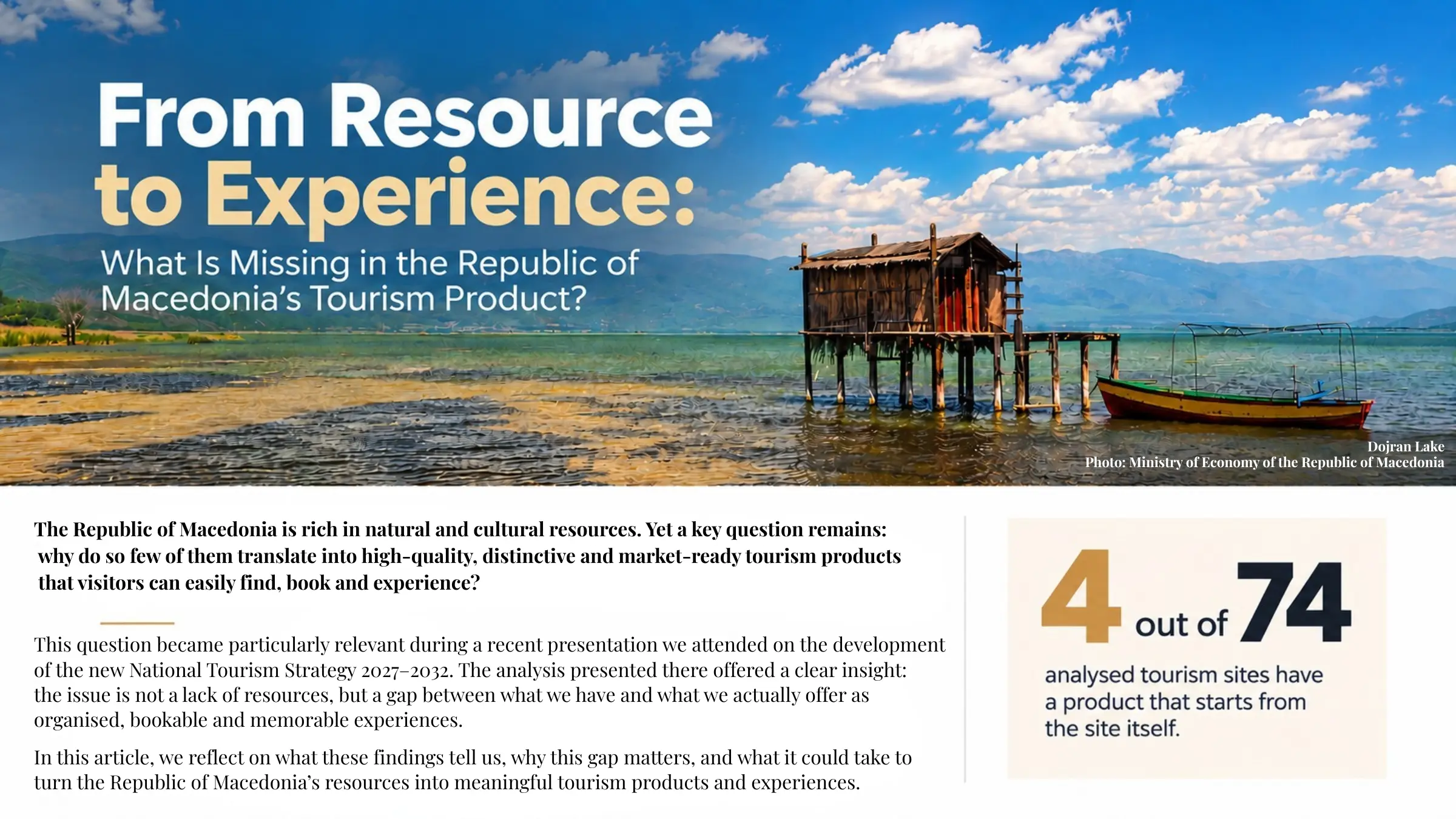
Among the findings presented, one figure stood out: out of 74 analysed tourism sites, 54 are visible on tourism platforms, 42 have a commercial product, 35 have a bookable product, 24 have a dedicated product, and only 4 have a product that starts from the site itself.
The gap is striking.
A resource is not yet a product
A beautiful landscape is a resource. An archaeological site is a resource. A museum collection, a historic building, a traditional craft or a local story can all be exceptional resources.
But their existence alone does not make them tourism products.
The challenge begins when we ask what a visitor can actually do with them. Can the experience be discovered before arrival? Is there a clearly defined offer? Can it be booked? Does it provide a reason to stay longer? Does it connect visitors with the place in a meaningful way?
This distinction becomes particularly important when we talk about natural and cultural heritage. Whether it is a museum, archaeological site, historic place, national park or natural landscape, exceptional value alone does not automatically translate into a meaningful visitor experience.
A destination is not an experience
The same distinction applies on a larger scale.
A destination may have mountains, lakes, archaeological sites, historic towns, traditional food and local communities. These elements provide enormous potential, but the destination itself is still not an experience.
Experiences have to be intentionally developed around what makes a place distinctive.
For tourism development, this distinction matters economically as well. If visitors have few opportunities to participate in activities, engage with local heritage, discover additional experiences or purchase locally developed products, the destination captures only a fraction of the potential value of their visit.
The question is therefore not simply how to attract more visitors.
It is also what we offer them once they arrive.
From academic knowledge to practice
One positive aspect of the current strategy-development process is the involvement of expertise from different academic institutions working in tourism. Bringing different perspectives together is particularly valuable in a relatively small tourism market.
The next step should be an equally strong connection between research, institutions and practitioners working directly on the development of tourism products and visitor experiences.
The analysis has already identified the gap between resources and market-ready products. The strategic challenge is now to address that gap through concrete measures, responsibilities, investment and implementation.
This will become particularly important as the strategic framework moves towards its Action Plan.
The opportunity lies in the space between
The Republic of Macedonia does not lack resources.
What remains underdeveloped is the space between possessing a resource and turning it into something that visitors can discover, understand, participate in, book and remember.
This space represents a significant opportunity for interpretation, storytelling and experience design across tourism.
Because the journey from resource to tourism product does not happen by itself.
It has to be designed.
Photo: Doјran Lake, Ministry of Economy of the Republic of Macedonia.
Author: Vasilka Dimitrovska, MSci
Experience Designer & Heritage Innovation Strategist
Founder & CEO, KREAKTIVA: The Storytelling & Experience Design Studio