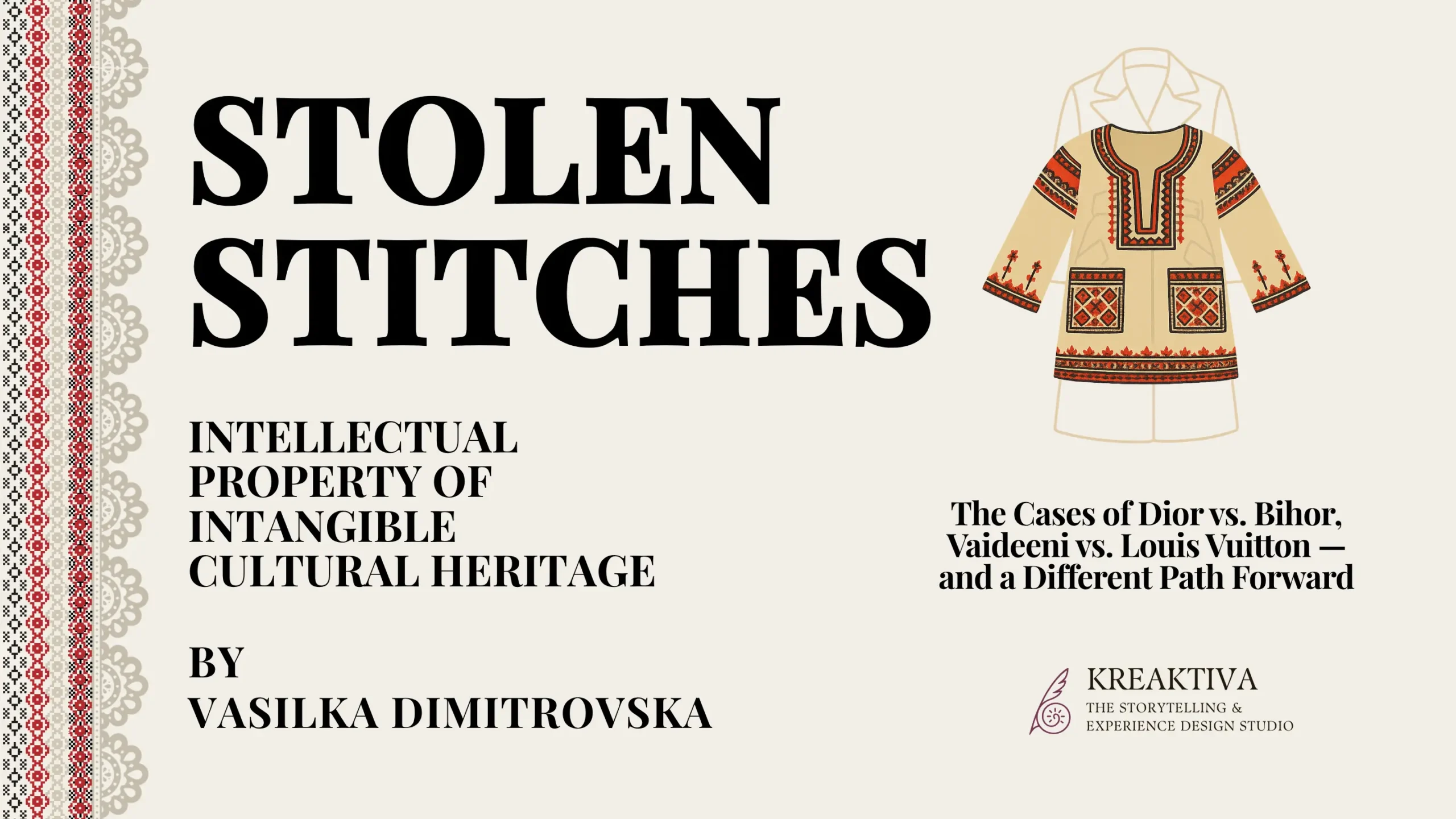
The Cases of Dior vs. Bihor, Vaideeni vs. Louis Vuitton, and a Different Path Forward
Traditional clothing is never just decoration.
A cut, a stitch, a colour combination or an embroidered motif may carry generations of knowledge, local identity and cultural memory. In many communities, these skills and designs have been transmitted for decades or centuries without a single identifiable author.
But what happens when something created and preserved collectively enters the global fashion market?
Who owns a traditional design?
And what happens when intangible cultural heritage collides with global fashion?
These questions are no longer theoretical.
Dior and Bihor
In 2017, a coat from Dior’s Pre-Fall collection drew attention in Romania because of its striking similarity to the traditional cojocel binșenesc from the Bihor region.
The issue was not simply that a luxury fashion house had found inspiration in traditional clothing. The controversy centred on recognition, attribution and economic benefit. Local craftspeople had preserved the knowledge and skills behind the garment, while the international fashion product circulated at a price far beyond that of the locally produced original. South China Morning Post
The response was particularly interesting.
Instead of stopping at criticism, Romanian creatives and craftspeople developed Bihor Couture, connecting traditional makers directly with an international audience and returning economic value to the community. The initiative became an example of how a conflict over appropriation could generate visibility, renewed interest in traditional craftsmanship and new opportunities for its bearers. ZoneModa Journal
Vaideeni and Louis Vuitton
Several years later, another Romanian case raised almost the same questions.
In 2024, members of the community of Vaideeni recognised elements of their traditional blouse in a Louis Vuitton design from the brand’s resort collection.
The traditional Romanian blouse is not simply a fashion silhouette. Its making involves knowledge of construction, embroidery, motifs and techniques transmitted through communities. The craft of the traditional blouse was inscribed on UNESCO’s Representative List of the Intangible Cultural Heritage of Humanity in 2022.
Community representatives and the organisation La Blouse Roumaine called for recognition of the origin of the design and for the involvement and consent of the communities concerned. Louis Vuitton subsequently apologised and stopped selling the blouse. eNCA
Different moment. Different fashion house.
But essentially the same question:
What happens when living heritage becomes raw material for a global commercial product?
Intangible Heritage as Intellectual Property
This is where the problem becomes complicated.
Conventional intellectual property systems were largely designed around identifiable creators, defined works and limited periods of protection.
Intangible cultural heritage often works in an entirely different way.
A traditional motif may have no known individual author.
A technique may have been transmitted collectively through generations.
A design may exist in numerous variations within the same community.
Knowledge may be shared rather than individually owned.
This makes it difficult to fit living heritage neatly into conventional categories of copyright, patents or trademarks. International discussions around cultural heritage and intellectual property have therefore increasingly focused on traditional knowledge and traditional cultural expressions, precisely because collective heritage does not always correspond to legal systems built around individual authorship.
But the absence of a simple legal answer does not mean that there is no responsibility.
The Challenges
The cases above expose several recurring problems:
- traditional knowledge often has no single identifiable author;
- communities may have little control over how their cultural expressions are commercially used;
- global brands have vastly greater visibility and economic power than local craftspeople;
- legal protection and ethical responsibility are not always the same thing.
And perhaps most importantly, something can be legally accessible and still be culturally sensitive.
That distinction matters.
Innovation Instead of Appropriation
The question is not whether designers should stop being inspired by cultural heritage.
Culture has always travelled, influenced and inspired.
The more interesting question is what happens next.
Does inspiration erase the source?
Or can it create a relationship with the people who carry the knowledge?
The Bihor response demonstrated one possible direction: instead of allowing the traditional garment to remain merely a visual reference for someone else’s product, local craftspeople became visible participants in the story.
Recognition, attribution, collaboration and economic participation can radically change the relationship between heritage and contemporary design.
The same principle extends far beyond fashion.
It applies whenever traditional crafts, stories, symbols, rituals, foodways, music or other forms of living heritage become part of contemporary cultural and creative products.
Why This Matters
For me, this subject is both professional and personal.
As an archaeologist, heritage consultant and bearer of intangible cultural heritage, I have spent years working with the relationship between heritage, communities, interpretation and contemporary audiences.
That experience also informs the work of KREAKTIVA.
When living heritage enters a contemporary project, the starting point cannot simply be: How can we use this?
A much better question is:
How can we work with it responsibly?
For KREAKTIVA, this means respecting the origins of heritage, acknowledging its bearers and supporting ways in which stories, traditions and knowledge can be presented and communicated without separating them from the people and communities that give them meaning.
Heritage can inspire contemporary creativity.
But inspiration should not make its source invisible.
And perhaps the most interesting future lies not in choosing between tradition and innovation, but in finding ways for both to create value together.
Author
Vasilka Dimitrovska
Founder & Creative Director, KREAKTIVA
Heritage Consultant and Certified Interpretive Trainer
KREAKTIVA • Living Heritage
Working with living heritage?
We support cultural organisations, communities and creative professionals in developing responsible ways to communicate and present heritage while respecting its context, origins and bearers.