Every year, around June 21, the Sun reaches its highest point in the Northern Hemisphere. This is the summer solstice — the longest day of the year, when the Sun seems, for a brief moment, to stand still in the sky.
For many of us today, the summer solstice marks the beginning of summer: a warm day, a short night, a seasonal moment in the calendar. But if we step away from modern comfort and look back through the centuries, this day once stood on the threshold between survival and uncertainty.
Across Europe, this phenomenon lit the fires of communities. In the North, these days are known as Midsummer; in the East, as the magical Kupala Night (Noc Kupały), with countless local traditions. In Macedonia, through traditions that changed calendars over time but preserved their deeper meaning, echoes of this symbolism can still be felt in the rituals of Tajane and the ceremonial songs of Ivanki, on the eve of the Nativity of St. John the Baptist — Ivanden.
Human beings have always felt a primal need to celebrate the victory of light over darkness.
Some of the earliest traces of this fascination go back to prehistoric communities who aligned monuments, landscapes, and ritual spaces with the rising or setting Sun. From Stonehenge to other ancient sites across Eurasia, people gathered the sky, the earth, and the human community into one shared moment of meaning.
But in Macedonia, one of the most powerful places where this dialogue between stone, sky, and time can still be felt is Kokino.
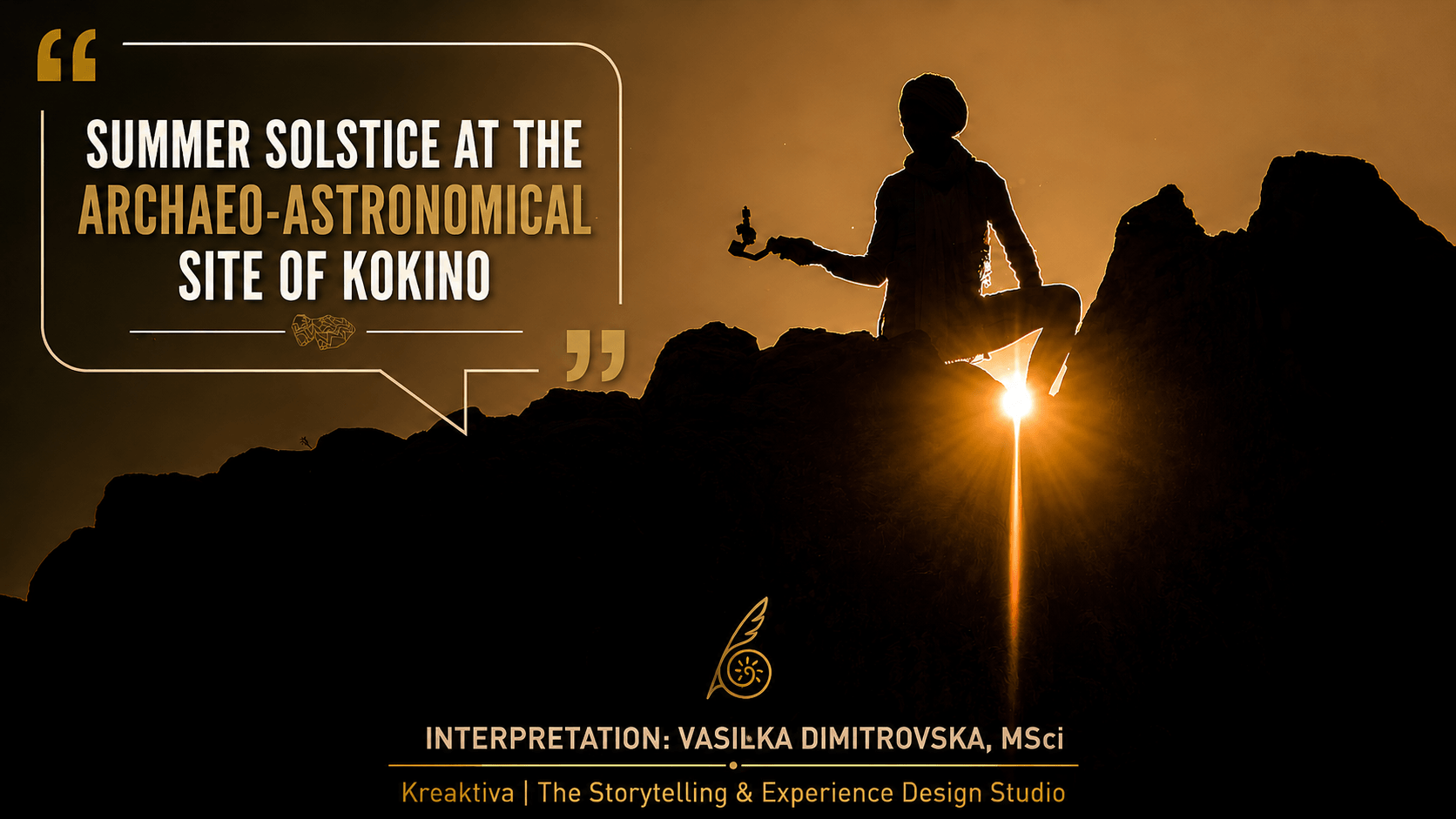
Dating back to the Bronze Age, around 1800 BCE, Kokino is one of the most remarkable archaeoastronomical sites in the region. According to astronomical research, one of the key points observed by the local community at this site was precisely the marker of the summer solstice.
Imagine that prehistoric community standing on these stone slopes.
For them, the sky was not a romantic backdrop — a place for camping under the stars or photographing the night sky. It was an essential guide for survival. Without clocks, calendars, or apps, they had to “catch” time. And they did so with astonishing precision.
They observed the Sun rising exactly through the carved stone marker of the summer solstice. That morning ray, illuminating the corresponding notch at Kokino, was a sign that nature had reached its peak, that the cycle had come full circle, and that it was time to prepare for the fruits that meant life.
Kokino is not merely a collection of archaeological and astronomical data.
It is a living monument to the human mind — to the desire to understand order in the cosmos and to find our place within it. These stone markers bear witness to the moment when human beings ceased to be silent observers of nature and became its interlocutors.
At KREAKTIVA, Kokino is not only a place we write about. It is a landscape we interpret through carefully designed gamified heritage experiences and team building modules.
Through storytelling, observation, symbolic tasks, and shared discovery, we help visitors connect with Kokino not only as an archaeological site, but as a living dialogue between people, nature, time, and the sky.
This is the essence of heritage interpretation: transforming facts into meaning, places into experiences, and ancient landscapes into personal encounters.
As the longest day of the year returns again and again, Kokino reminds us of an unbroken continuity. The same sunlight that warms us today was welcomed with reverence here almost four millennia ago.
In the end, time flows, calendars change, civilizations fade — but our need to look up at the sky and search for meaning remains forever the same.
Discover more about our Kokino experiences at kokino.mk.
Wherever you are, catch the light. ✨
Author:
Vasilka Dimitrovska, MSci
Experience Designer & Heritage Innovation Strategist
Founder & CEO, KREAKTIVA: The Storytelling & Experience Design Studio
UNESCO Intangible Cultural Heritage Safeguarding Practitioner
Certified Interpretive Trainer (CIT)
Certified Trainer in Live Interpretation / Costumed Storytelling